Bambu A1 vs P1S vs X1 Carbon (2026): Which to Buy, plus P2S, X2D and H2
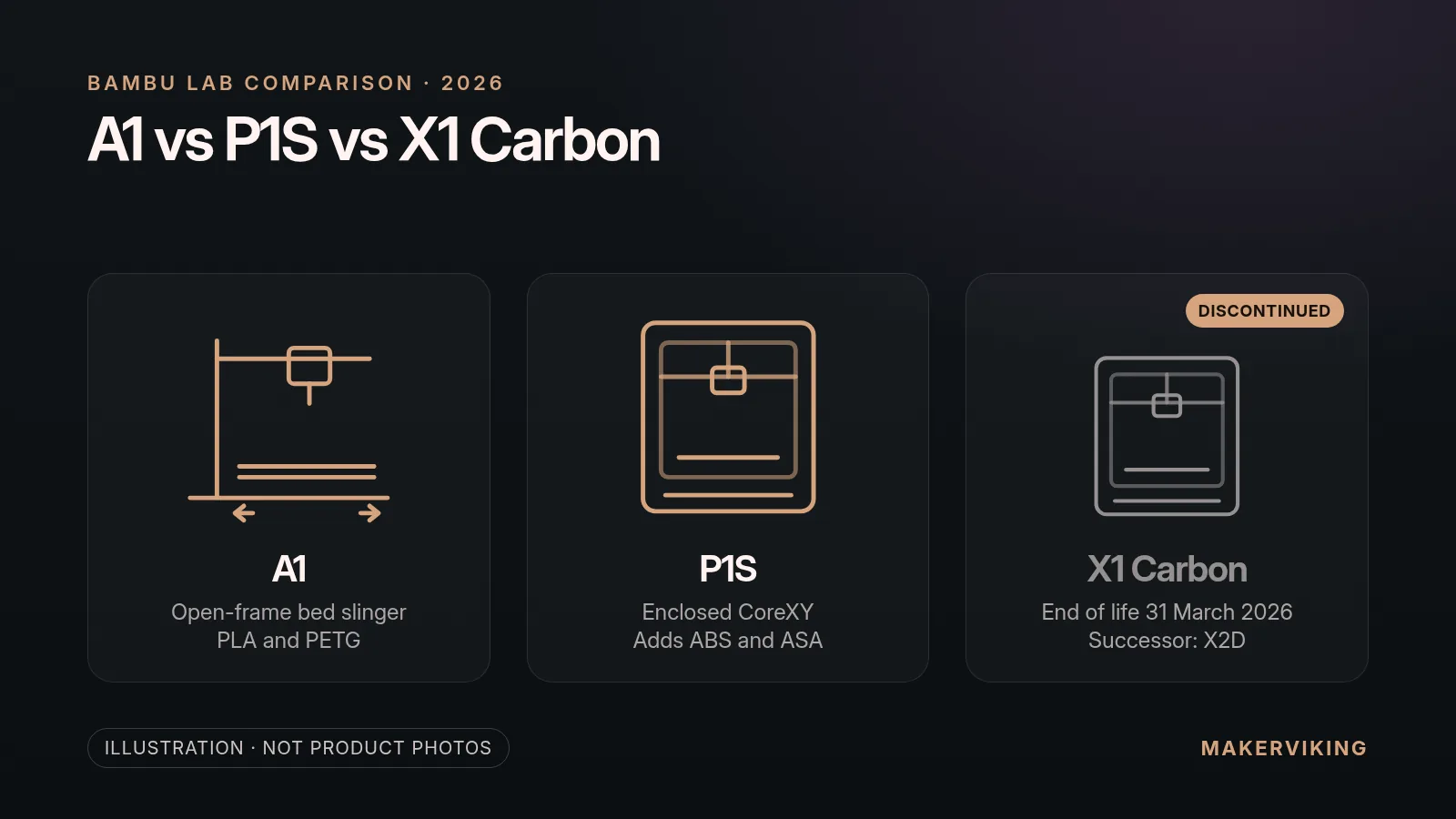
Updated 17 November 2026. This guide covers every current Bambu Lab 3D printer: the A1 mini, A1, A2L, P1S, P2S, X2D, H2S, H2D, H2D Pro and H2C. The X1 Carbon went end-of-life on 31 March 2026.
Prices are from the Bambu Lab US store on 29 October 2026, during its Black Friday sale. I could not reload the US store on 17 November, so check the live price before you buy.
Short answer: The Bambu Lab X1 Carbon is discontinued, so pick from the current lineup by what you print. Buy the A1 mini or A1 for PLA and PETG, the A2L for big PLA parts on a budget, the P1S as the cheapest enclosed printer for ABS and ASA, the P2S for carbon-fiber filaments and the X2D, the X1 Carbon's successor, for dual nozzles and a heated chamber. Choose the H2 series for large-format, 350 °C and multi-material printing.
Some links on this page are Amazon affiliate links (see the disclosure below). Bambu Lab P1S on Amazon · Bambu Lab A1 on Amazon
A1 vs P1S: which should you buy?
The A1 is the better buy if you will mostly print PLA and PETG, and the P1S is the one for ABS or ASA.
If ABS or ASA appears anywhere on your list, the choice makes itself. The P1S's enclosure keeps heat in, and its CoreXY motion has twice the A1's acceleration (20,000 vs 10,000 mm/s²).
On 29 October 2026 the A1 started at $259 and the P1S at $349 on Bambu Lab's US store, so the P1S cost about $90 more.
X1 Carbon vs P1S: which should you buy?
The P1S is the Bambu Lab printer to buy new, because Bambu stopped making the X1 Carbon on 31 March 2026.
The X1 Carbon's advantages were a hardened steel nozzle for fiber-filled filaments, a Micro Lidar and a hotter bed. The P2S or X2D is the current replacement if you need those extras. A discounted X1 Carbon only makes sense if it costs less than a P2S.
If you want a current replacement, including non-Bambu options, see my guide to what to buy instead of the X1 Carbon.
Is the Bambu Lab X1 Carbon discontinued?
The X1 Carbon is discontinued. Bambu Lab ended manufacturing and active sales of the X1, X1 Carbon and X1E on 31 March 2026.
According to Bambu Lab's EOL announcement, existing machines keep firmware feature updates until 31 May 2027, security patches until 31 May 2029 and spare parts until 31 March 2031. The same post notes the P1P had already been retired the month before.
Bambu calls the X2D "X1C's next chapter" on its X2D store page.
Weighing an A1 Combo against an X1 Carbon? See my A1 Combo vs X1 Carbon guide for 2026.
Current Bambu Lab printers: entry and mid-range comparison
The P1S is the cheapest enclosed printer in this table, and the A1 mini is the cheapest overall.
Six printers, two body styles. The A1 mini, A1 and A2L are open-frame bed slingers; the P1S, P2S and X2D are enclosed CoreXY printers with a 256 mm class build volume.
| Spec | A1 mini | A1 | A2L | P1S | P2S | X2D |
|---|---|---|---|---|---|---|
| US price, 29 Oct 2026 (from / typical) | $199 / $219 | $259 / $299 | $439 / $469 | $349 / $399 | $449 / $549 | $589 / $649 |
| Build volume | 180 × 180 × 180 mm | 256 × 256 × 256 mm | 330 × 320 × 325 mm | 256 × 256 × 256 mm | 256 × 256 × 256 mm | 256 × 256 × 260 mm |
| Motion / frame | Bed slinger, open | Bed slinger, open | Bed slinger, open | CoreXY, enclosed | CoreXY, enclosed | CoreXY, enclosed, dual nozzle |
| Chamber heating | None | None | None | Passive | Passive | Active, 65 °C |
| Max speed / accel. | 500 mm/s, 10,000 mm/s² | 500 mm/s, 10,000 mm/s² | 500 mm/s, 10,000 mm/s² | 500 mm/s, 20,000 mm/s² | 600 mm/s, 20,000 mm/s² | 1,000 mm/s, 20,000 mm/s² |
| Nozzle / max temp | Stainless, 300 °C | Stainless, 300 °C | Stainless, 300 °C | Stainless, 300 °C | Hardened, 300 °C | Hardened, 300 °C |
| Max bed temp | 80 °C | 100 °C | 80 °C | 100 °C | 110 °C | 120 °C |
| Best materials | PLA, PETG, TPU, PVA | PLA, PETG, TPU, PVA | PLA, PETG, TPU, PVA (CF with hardened nozzle) | + ABS, ASA (PA/PC capable) | + PC, CF/GF nylons | + PA, PC, PPA-CF |
Bambu Lab H2 series comparison: H2S vs H2D vs H2D Pro vs H2C
The H2S is the H2 to pick for one big material, the H2D for two materials and the H2C for heavy multi-color work.
When a part needs a 350 °C nozzle, the H2 series is the only Bambu option. The X2D tops out at 300 °C.
All four share a 350 °C hardened or tungsten-carbide nozzle, a 65 °C actively heated chamber, a 120 °C bed, 1,000 mm/s top speed and G3 + H12 HEPA + activated carbon filtration. All four support PPS and PPA composites.
| Spec | H2S | H2D | H2D Pro | H2C |
|---|---|---|---|---|
| US price, 29 Oct 2026 (from / typical) | $1,049 / $1,199 | $1,399 / $1,549 | Authorized resellers only | $1,899 / $2,199 |
| Nozzles | Single | Dual | Dual, tungsten carbide | Dual, with Vortek hotend changing (up to 7 hotends) |
| Build volume | 340 × 320 × 340 mm | 325 × 320 × 325 mm single nozzle; 350 × 320 × 320 mm total for two nozzles | Same as H2D | 330 × 320 × 320 mm total for two nozzles |
| Max nozzle temp | 350 °C | 350 °C | 350 °C | 350 °C, induction heating |
| Laser / cutter | Optional 10 W laser, cutting module | Optional 10 W / 40 W laser, cutting module | Not listed | Optional 10 W / 40 W laser, cutting module |
| Extras | Biggest single-nozzle volume | Two materials per print | Ethernet, network kill switch, 802.1X | Least purge waste for multi-color |
| Best for | Large parts, 350 °C materials | Dual-material engineering parts | Businesses and labs with IT rules | Heavy multi-color and multi-material work |
Spec data from Bambu Lab: A1 mini, A1, A2L, P1S, P2S, X2D, H2S, H2D, H2D Pro and H2C spec pages. Price data from the Bambu Lab US store, checked 29 October 2026. Bambu discounts often, so check the live price.
Affiliate disclosure: some links on this page are Amazon affiliate links. As an Amazon Associate, MakerViking earns from qualifying purchases at no extra cost to you. It does not change which printer we recommend.
Bambu Lab says it does not authorize third-party Amazon sellers, so check that the seller is Bambu Lab before you buy. Models not sold on Amazon.com link to Bambu Lab's own store.
Bambu Lab A1 mini and A1: best for beginners
The A1 is the best Bambu Lab printer for beginners who print PLA and PETG. It has a 256 × 256 × 256 mm build volume for about $90 less than a P1S on the 29 October prices.
Bambu itself draws the line. On the A1 spec sheet it rates PLA, PETG, TPU and PVA as "ideal" and lists ABS, ASA, PC, PA and fiber-filled filaments as "not recommended".
The A1 mini is the same idea in a 180 × 180 × 180 mm size, with an 80 °C bed and a 150 W maximum power draw. At $199 on 29 October 2026, it was the cheapest way in.
Bambu Lab A1 on Amazon · Bambu Lab A1 mini on Amazon
Bambu Lab A2L: big build volume on a budget
The A2L is the cheapest large-format Bambu Lab printer, at $439 on 29 October 2026, according to the A2L specs and the US store. It has a servo extruder, hardened steel gears, a 300 °C stainless nozzle and an 80 °C bed.
330 × 320 × 325 mm, on a bed slinger. That is close to the H2 series' build volume at a fraction of the price.
Bambu rates it for PLA, PETG, TPU and PVA, and for PLA-CF and PETG-CF once you fit a hardened steel nozzle. It also supports a blade-cutting and pen-plotting module. Skip it for ABS or ASA, since it has no enclosure.
Bambu Lab A2L at the Bambu Lab store (not currently sold on Amazon.com)
Bambu Lab P1S: best budget enclosed printer
The P1S is the cheapest Bambu Lab printer that handles ABS and ASA reliably. It is an enclosed CoreXY printer with 500 mm/s top speed, 20,000 mm/s² acceleration, a 300 °C all-metal hotend and an activated carbon filter.
Every printer above this one sits open to the room. The P1S is the first with walls, and the walls are what ABS and ASA need.
Bambu lists PLA, PETG, TPU, PVA, PET, ABS and ASA as ideal and PA and PC as capable. The stock nozzle is stainless steel, and Bambu does not recommend carbon- or glass-fiber filaments without a hotend upgrade, according to the P1S store FAQ.
Bambu Lab P2S: the upgraded P1S
The P2S is a better buy than the P1S if you want carbon-fiber filaments or more speed. Unlike the P1S, it ships with a hardened steel nozzle and gears.
Carbon-fiber filament wears down a stainless nozzle. Bambu does not recommend it on the P1S's stock hotend, and the P2S fixes that from the box.
It also adds 600 mm/s top speed, a 110 °C bed, a servo (PMSM) extruder, a 5-inch touchscreen, AI print-failure detection and a tool-free quick-swap hotend, per the P2S specs. The chamber is not actively heated, and WIRED's P2S Combo review notes it shakes light tables at full speed.
Bambu Lab X2D: the X1 Carbon replacement
The X2D is the printer to buy if you were looking at an X1 Carbon. Bambu calls it "X1C's next chapter", and the spec sheet backs that up.
The X2D has two nozzles, a 65 °C actively heated chamber, a 120 °C bed, 1,000 mm/s top speed, HEPA plus carbon filtration, and live-view and toolhead cameras, according to the X2D specs.
Bambu says it is UL 2904 certified for indoor air quality with Bambu PLA Basic and PETG Basic. Its nozzles top out at 300 °C, so PPS still needs an H2 printer.
Bambu Lab X2D at the Bambu Lab store (the Amazon.com listing is currently unavailable)
Bambu Lab H2S: largest single-nozzle build volume
The H2S is the Bambu Lab printer for the biggest single parts. It prints 340 × 320 × 340 mm with one 350 °C hardened steel nozzle and a 65 °C heated chamber, and supports PPS and PPA composites, per the H2S specs.
One big part, one material, 340 mm tall. Nothing else in the lineup is taller.
A Laser Edition adds a 10 W laser and the cutting module. On the 29 October prices it cost $350 less than the H2D, because it has one nozzle instead of two.
Bambu Lab H2S at the Bambu Lab store (not currently sold on Amazon.com)
Bambu Lab H2D and H2D Pro: dual-nozzle engineering printers
The H2D is the Bambu Lab printer for two-material engineering parts.
With two nozzles, the part and its support material print from separate hotends. That is the whole case for the H2D. It has two 350 °C nozzles, a 65 °C heated chamber and a 350 × 320 × 320 mm total volume for both nozzles.
Laser Edition options take a 10 W or 40 W laser module, which can cut basswood plywood up to 15 mm with the 40 W module, per the H2D specs.
The H2D Pro keeps the same volume and adds a tungsten carbide nozzle, Ethernet, a network kill switch and 802.1X network access control, per the H2D Pro specs. Bambu sells the H2D Pro only through authorized resellers.
Bambu Lab H2D at the Bambu Lab store (the Amazon.com listing is currently unavailable) · Bambu Lab H2D Pro at the Bambu Lab store (resellers only)
Bambu Lab H2C: multi-material without the purge waste
The H2C is the Bambu Lab printer for heavy multi-color and multi-material printing. Its Vortek system swaps whole induction-heated hotends instead of purging, so one print can use up to seven materials, with 8-second hotend heating, according to the H2C store page.
532 g of purge waste against 3,032 g. That is Bambu's own Bambu Studio calculation for one multi-color model, H2C first, H2D second.
Build volume is 330 × 320 × 320 mm for both nozzles, per the H2C specs.
Bambu Lab H2C at the Bambu Lab store (not currently sold on Amazon.com)
X1 Carbon vs P1S: what is the difference?
The X1 Carbon is the better-equipped machine and the P1S the cheaper, simpler one.
On paper they look like twins: both enclosed CoreXY, both 256 × 256 × 256 mm, both 500 mm/s and 20,000 mm/s². Most of the differences sit in the toolhead and the bed.
The X1 Carbon adds a hardened steel nozzle and extruder gears for carbon- and glass-fiber filaments, a Micro Lidar for first-layer and flow calibration, a 5-inch touchscreen and a hotter bed.
In 2026 the bigger difference is availability. The X1 Carbon was discontinued on 31 March 2026, while the P1S is still sold, at $349 (typically $399) on Bambu Lab's US store on 29 October 2026.
| Spec | X1 Carbon (discontinued) | P1S |
|---|---|---|
| Status | End of life 31 Mar 2026 | Current |
| Build volume | 256 × 256 × 256 mm | 256 × 256 × 256 mm |
| Max speed / acceleration | 500 mm/s, 20,000 mm/s² | 500 mm/s, 20,000 mm/s² |
| Nozzle and extruder gears | Hardened steel, 300 °C | Stainless steel nozzle, 300 °C |
| Max bed temperature | 110 °C (220 V) / 120 °C (110 V) | 100 °C |
| Chamber | Enclosed, up to 60 °C | Enclosed, passive |
| Calibration extras | Micro Lidar | None (standard auto calibration) |
| Ideal fiber-filled filaments | Yes (carbon and glass fiber) | Needs a hardened nozzle upgrade |
| US price (29 Oct 2026) | No longer sold new by Bambu | $349 (typically $399) |
X1 Carbon specs are from the X1-Carbon spec sheet and X1 product page. P1S figures match the comparison table above.
If you want what the X1 Carbon offered over the P1S today, the P2S adds a hardened steel nozzle and a 110 °C bed, and the X2D adds dual nozzles and an actively heated chamber. For the multicolor angle, see A1 Combo vs X1 Carbon.
Which Bambu Lab printer should you buy?
The best-value Bambu Lab printer, in my view, is the P1S: the cheapest enclosed model at $349 on 29 October 2026, and it adds ABS and ASA over the A1.
Otherwise, start with the material, then the size. Pick by what you print:
- First printer, PLA and PETG only: A1 mini (small desk) or A1.
- Large PLA or PETG parts, cosplay, props: A2L.
- ABS and ASA on a budget: P1S.
- Carbon-fiber filaments and faster prints: P2S.
- Nylon and PC with a heated chamber, two materials, or replacing an X1 Carbon: X2D.
- Large parts in 350 °C materials such as PPS: H2S.
- Large dual-material parts, or a laser/cutter in one machine: H2D.
- Business network requirements (Ethernet, 802.1X): H2D Pro.
- Lots of colors or materials per print with little waste: H2C.
- Multicolor on a mid-range budget, outside Bambu: the four-toolhead Snapmaker U1 ($699 on Snapmaker's US store on 17 November 2026), compared in Snapmaker U1 vs Bambu Lab P2S.
Outside Bambu Lab, the Snapmaker U1 is a four-toolhead toolchanger with a 270 × 270 × 270 mm build volume. It is a far cheaper way to get purge-free multicolor printing than the H2C, and it cost only $50 more than the P2S Combo's $649 on 29 October, so it's the multicolor printer I'd pick in that price range.
In my opinion it's the first really affordable toolchanger that's actually good. See my recommended 3D printers list. Snapmaker U1 on Amazon (affiliate link).
Still unsure? These guides go deeper on one question each:
- First printer: the best beginner 3D printers guide and the $300 budget guide.
- Material choice: PLA vs PETG and the filament guide.
- Once the printer arrives: my list of first things to 3D print on a new printer and the slicer settings that matter.
- Real makers' printers and materials: TinkerAtlas printers and the TinkerAtlas filament compatibility tool.
- Multicolor methods: how AMS and toolchangers differ in multicolor 3D printing explained.
FAQ
Is the Bambu Lab X1 Carbon still worth buying?
The X1 Carbon is worth buying only as a discounted, in-stock unit from an authorized distributor. Production ended on 31 March 2026, and firmware feature updates stop on 31 May 2027. For a new purchase, the X2D is Bambu's stated successor, from $589 on Bambu Lab's US store on 29 October 2026.
X1 Carbon vs P1S: which should I buy?
The P1S is the one to buy new in 2026, because the X1 Carbon was discontinued on 31 March 2026. The X1 Carbon's advantages were a hardened steel nozzle for fiber-filled filaments, a Micro Lidar and a hotter bed. If you need those, the P2S or X2D is the current replacement, and a discounted X1 Carbon only makes sense if it costs less than a P2S.
Bambu Lab A1 vs P1S: which should I buy?
The A1 is the better buy if you will mostly print PLA and PETG. Buy the P1S if you want ABS or ASA, because its enclosure keeps heat in, and its CoreXY motion has twice the A1's acceleration (20,000 vs 10,000 mm/s²). The P1S cost $90 more on Bambu Lab's US store on 29 October 2026.
P1S vs P2S: is the upgrade worth $100?
The P2S upgrade is worth it if you print carbon- or glass-fiber filaments or want the newer features: a hardened steel nozzle, 600 mm/s, a 110 °C bed, AI failure detection and a quick-swap hotend. For PLA, PETG, ABS and ASA, the P1S does the job for less ($349 vs $449 on 29 October 2026).
H2D vs H2S: what is the difference?
The main H2D vs H2S difference is nozzle count: the H2D has two nozzles and the H2S has one. The H2S gives the larger single-nozzle volume (340 × 320 × 340 mm vs 325 × 320 × 325 mm) and cost $350 less on 29 October 2026 (from $1,049 vs $1,399). Both have 350 °C nozzles and a 65 °C heated chamber.
H2D vs H2C: which is better for multi-color printing?
The H2C is better for multi-color printing because its Vortek system swaps hotends instead of purging filament. In Bambu's own Bambu Studio example it used 532 g of purge waste against 3,032 g on the H2D. The H2D was $500 cheaper on 29 October 2026 and is enough for two-material prints.
Bambu A1 vs X1 Carbon: which should I buy?
The A1 is the one to buy new for PLA and PETG, because the X1 Carbon was discontinued on 31 March 2026. The X1 Carbon was an enclosed CoreXY printer with a hardened steel nozzle, so its replacement for ABS, ASA and fiber-filled filaments is the P2S or X2D, not the A1. For the multicolor version of this question, see A1 Combo vs X1 Carbon.
What replaced the Bambu Lab X1 Carbon?
The X2D is the X1 Carbon's replacement: Bambu calls it "X1C's next chapter" on its X2D store page. It adds a second nozzle, a 65 °C actively heated chamber and a 120 °C bed, and it started at $589 on Bambu Lab's US store on 29 October 2026.
Which Bambu Lab printers can print carbon fiber?
The printers that take carbon-fiber filaments out of the box are the P2S, X2D and every H2 printer, because they ship with hardened steel nozzles. The A2L takes PLA-CF and PETG-CF once you fit a hardened steel nozzle. The P1S, A1 and A1 mini have stainless nozzles, and Bambu does not recommend fiber-filled filaments on them without an upgrade.
Can the Bambu Lab A1 print ABS?
The A1 is not recommended for ABS: Bambu lists ABS, ASA, PC and PA as "not recommended" on the A1 and A1 mini because they have no enclosure. Use a P1S, P2S, X2D or H2 printer for those materials.
Which Bambu Lab printers are sold on Amazon?
Four Bambu Lab printers are sold on Amazon in the US: the A1 mini, A1, P1S and P2S, when I checked on 29 October 2026. The X2D and H2D listings were unavailable, and the A2L, H2S and H2C had no Amazon.com printer listing, so buy those from Bambu Lab's store. The H2D Pro is sold only through authorized resellers.
What build volume do Bambu Lab printers have?
The A1, P1S and P2S are 256 × 256 × 256 mm printers, the X2D is 256 × 256 × 260 mm and the A1 mini is 180 × 180 × 180 mm. The A2L (330 × 320 × 325 mm) and the H2 series (up to 340 × 320 × 340 mm on the H2S) are the large-format options.